Author: Dr Rimjhim Agrawal (Ph.D.) , Global Head of AI & Analytics, Utilities
As renewable energy penetration increases, the complexity of managing wind, solar, and storage assets is growing rapidly. Operators are no longer dealing with predictable generation patterns, but with highly dynamic systems shaped by weather variability, grid constraints, and market volatility.
In this environment, traditional tools—SCADA systems, standalone forecasting models, and rule-based operations—are no longer sufficient.
AI-integrated digital twins are emerging as the next evolution in energy intelligence, enabling a shift from monitoring and forecasting toward simulation-driven decision-making.
Historically, renewable energy operations have been fragmented. SCADA systems provide real-time data, forecasting models predict generation, and operators make decisions based on experience or static rules. While each component is valuable, they often operate in isolation.
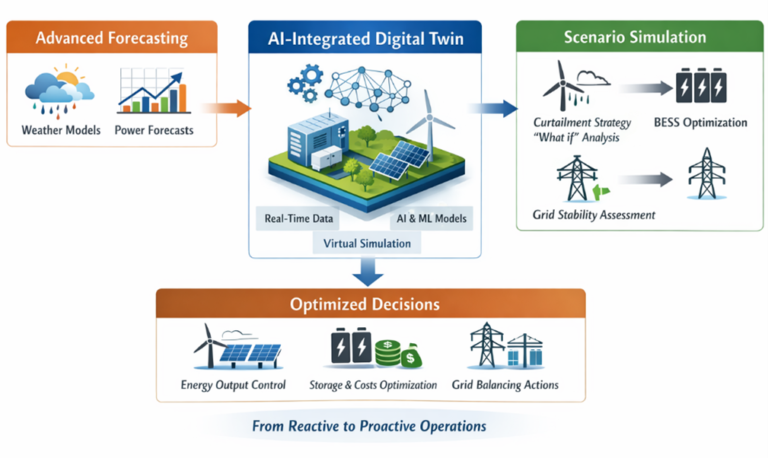
As illustrated in Figure 1, AI-integrated digital twins bridge this gap by creating a unified, dynamic model of an asset or system. When powered by AI, these systems continuously learn from both historical and real-time data, enabling a more accurate representation of system behavior under changing conditions.
This integration transforms disconnected tools into a cohesive intelligence layer—one that supports faster, more informed decision-making.
Forecasting answers a critical question: what is likely to happen? But in increasingly complex energy systems, that is no longer enough.
Operators must also understand: what should we do next?
AI-integrated digital twins enable this shift. By combining forecast inputs with physics-based models and machine learning, they allow operators to simulate different actions before implementing them.
For example, a wind operator may know expected generation for the next few hours—but key decisions remain:
• Should turbines be curtailed to avoid penalties?
• How will wake effects impact performance?
• What is the optimal strategy when combined with storage?
Simulation provides a way to evaluate these scenarios in advance, reducing uncertainty and improving outcomes.
The value of digital twins becomes clear across multiple use cases.
In wind energy, they help optimize turbine interactions and minimize wake losses. In solar operations, they enable better responses to irradiance variability and curtailment decisions. For battery storage systems, they support dynamic dispatch strategies aligned with market signals. At the grid level, they allow operators to anticipate and manage stability challenges.
Across these applications, the common thread is a shift from reactive adjustments to proactive optimization.
As AI capabilities advance and data ecosystems mature, digital twins are evolving beyond decision support tools. They are becoming the foundation for autonomous energy systems.
In such systems, decisions are not only simulated but also executed in real time—continuously optimizing performance across assets and markets. The role of operators shifts from manual control to strategic oversight.
This represents a fundamental transformation: from managing individual assets to orchestrating intelligent energy ecosystems.
AI-integrated digital twins are redefining how renewable energy systems are operated. By connecting forecasting, real-time data, and simulation into a unified framework, they enable a new level of operational intelligence.
For energy companies, the question is no longer whether to adopt digital twins, but how quickly they can integrate them into core operations.
In a world where variability is the norm, the ability to simulate before acting may become the most valuable capability of all.
4010, 4th floor, Wing B, Marvel Edge clover Park, Viman nagar, Pune, Maharashtra 411014