

AI-Driven Battery Storage: Optimizing BESS Operations in Volatile Energy Markets
Author: Dr Rimjhim Agrawal (Ph.D.) , Global Head of AI & Analytics, Utilities
How artificial intelligence helps battery asset managers maximize revenue, improve dispatch strategies, and unlock value in increasingly dynamic power systems
Battery Energy Storage Systems (BESS) are becoming essential to modern electricity systems as renewable energy penetration increases. Battery storage enables greater grid flexibility by balancing supply and demand, stabilizing power systems, and capturing value from fluctuating electricity prices.
Global battery storage capacity is expected to grow more than fivefold by 2030, driven largely by the rapid expansion of solar and wind generation. At the same time, electricity markets are becoming more volatile. Midday solar oversupply can push prices downward, while evening demand ramps and intermittent wind generation can trigger sharp price spikes.
In this environment, the economics of battery storage are increasingly defined not only by installed capacity, but by how intelligently storage assets are operated.
Battery operators must continuously decide whether to capture arbitrage opportunities, participate in ancillary service markets, support grid stability, or preserve capacity for future price events. As renewable penetration increases, these decisions must be made within fast-changing and unpredictable market conditions.
The Growing Complexity of BESS Operations
Battery storage is often described using a simple rule: charge when prices are low and discharge when prices are high. In practice, profitable battery operation is far more complex.
Asset managers must simultaneously consider:
- energy arbitrage opportunities
- participation in ancillary service markets
- battery degradation and lifecycle management
- state-of-charge constraints
- real-time and forecasted electricity prices.
Despite this complexity, many battery systems still rely on static dispatch strategies such as fixed price thresholds, predefined schedules, or manual operator decisions. These approaches struggle in highly dynamic electricity markets.
Static strategies often lead to missed revenue opportunities, inefficient participation in grid services, and dispatch decisions that do not account for battery degradation. As renewable penetration increases, battery operations increasingly resemble a multi-variable optimization problem rather than a rule-based process.
AI as the Decision Engine for Battery Optimization
Artificial intelligence is emerging as a powerful tool for managing this operational complexity.
AI-driven battery optimization platforms analyze multiple data streams simultaneously, including electricity price forecasts, renewable generation projections, demand patterns, grid conditions, and battery health data. Using predictive analytics and machine-learning models, these systems evaluate thousands of potential scenarios to determine optimal dispatch strategies.
This enables AI-driven battery optimization and improved battery revenue optimization across electricity markets. Rather than reacting to current price signals, AI systems anticipate market conditions and dynamically optimize battery dispatch.
For example, an AI platform may delay discharge during an early price spike if forecasts indicate a larger peak later in the evening or prioritize ancillary service participation during periods of grid stress.
AI Architecture for Intelligent Battery Operations
AI-enabled battery management platforms typically follow a layered architecture that converts diverse data inputs into optimized operational decisions.
Data Inputs include electricity price forecasts, renewable generation projections, demand signals, grid conditions, and battery health parameters.
An AI Decision Engine processes these inputs using predictive models and multi-objective optimization algorithms to evaluate revenue opportunities, operational constraints, and degradation impacts.
The system generates Dynamic Control Actions, such as optimal charge timing, discharge scheduling, and service prioritization, ultimately driving outcomes including improved battery dispatch optimization, increased revenue capture, and enhanced asset longevity.
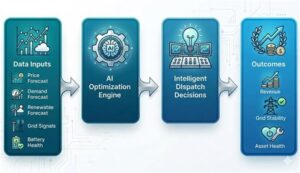
AI-Driven Architecture for Battery Storage Decision-Making
Emerging Demand: Data Centers and Microgrid Energy Systems
The growing demand for electricity from AI-driven data centers and distributed microgrid energy systems is further increasing the importance of intelligent battery operations.
Data center electricity demand is expected to rise significantly over the coming decade, prompting many operators to explore microgrid architectures that combine renewable generation with battery storage to ensure reliable and cost-effective power supply.
In these environments, AI-powered energy management platforms can optimize battery dispatch in response to fluctuating workloads, renewable variability, and grid conditions.
A New Competitive Advantage for Battery Asset Managers
As battery deployments expand, asset managers are increasingly managing fleets of storage assets across multiple markets and distributed energy resource (DER) networks.
AI platforms enable these assets to be optimized collectively, transforming distributed batteries into digitally coordinated energy portfolios.
In increasingly volatile electricity markets, competitive advantage will depend less on installed storage capacity and more on algorithmic intelligence and optimization capabilities.
Battery storage is evolving from a passive infrastructure asset into a real-time decision platform, and artificial intelligence is becoming the key technology unlocking its full economic potential.

