


Introduction
As software applications become more complex and release cycles get faster, traditional test automation struggles to keep up. Scripts need constant maintenance; application changes introduce failures, and QA teams spend a disproportionate share of their time updating and babysitting tests rather than writing new coverage.
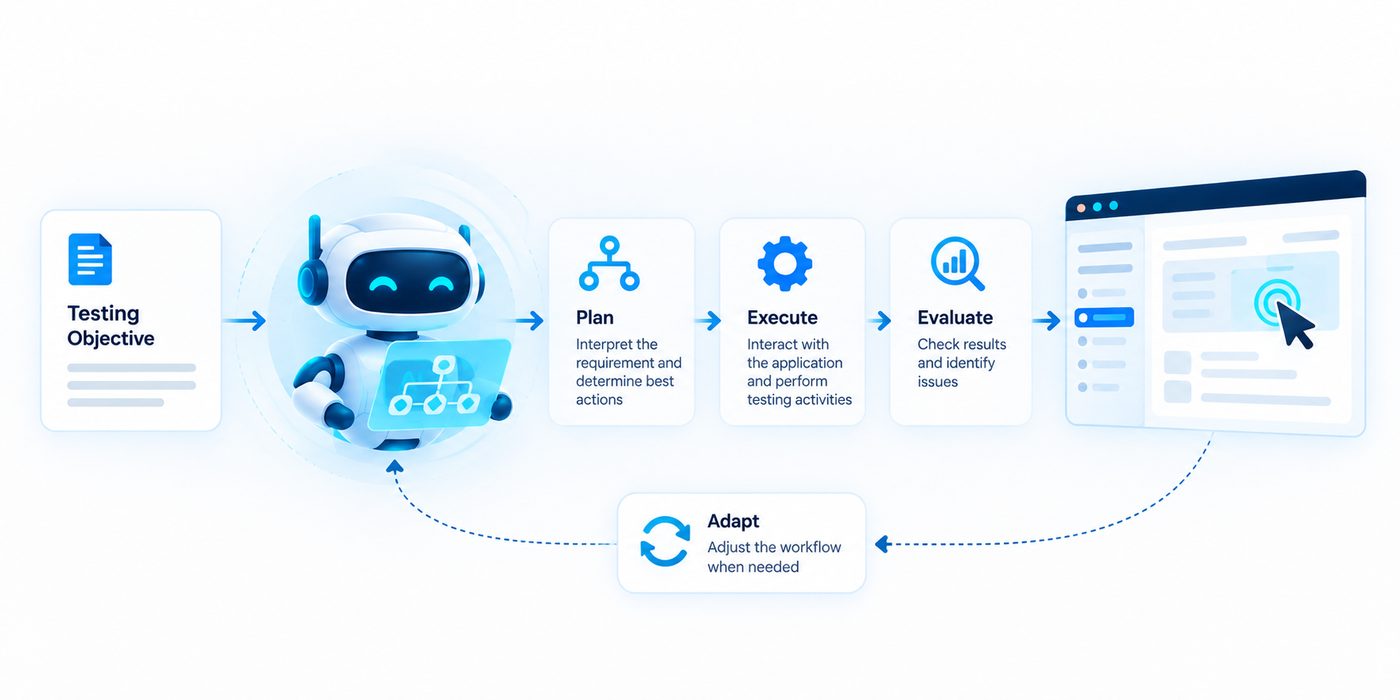
This is where agentic AI testing is gaining real attention. Unlike conventional automation, an agentic platform can use AI agents to understand a testing objective, plan the actions needed to meet it, generate test scenarios, execute them, analyze the results, and adapt when the application changes — with far less step-by-step human direction.
But not every platform marketed as “AI-powered” delivers the same level of capability, and the gap between a polished demo and a system that holds up in production is real. A recent Dataiku/Harris Poll survey of 800+ senior data leaders found that 75% say trust in their AI agent deployments is an active concern, and over half have delayed or blocked an agent deployment outright due to explainability gaps. That’s not a reason to avoid agentic testing — it’s a reason to evaluate it properly before committing budget to it.
This checklist explains what to look for.
Key Takeaways
- Agentic AI testing platforms can support multiple stages of the software testing lifecycle — not just test creation.
- Self-healing capabilities should be evaluated for accuracy, transparency, and auditability, not taken on faith.
- Integration with requirements, test environments, CI/CD pipelines, and existing automation matters for real enterprise adoption.
- Human review and validation remain important even in a highly autonomous system.
- The right platform depends on your application complexity, testing goals, existing infrastructure, and security requirements — not a generic feature list.
- Evaluate real workflows from your own environment, not just a vendor’s demo application.
What Is an Agentic AI Testing Platform?
An agentic AI testing platform uses AI agents to perform or coordinate testing activities based on a defined objective, rather than relying entirely on fixed, step-by-step scripts.
A traditional automation workflow requires an engineer to define every step explicitly: open the application, navigate to a page, select an element, enter test data, verify the result, move to the next step. An agentic approach can instead work from a higher-level objective — the system interprets the requirement, plans a sequence of actions, interacts with the application, evaluates what happened, and adapts the workflow when needed.
The degree of autonomy varies significantly between platforms. Some tools focus narrowly on AI-assisted test creation or maintenance; others coordinate multiple stages of the testing lifecycle through specialized agents. That distinction matters a great deal when you’re actually comparing options, and it’s the first thing worth clarifying with any vendor.
What Should You Look for in Agentic QA Tools?
A useful evaluation goes well beyond the phrase “AI-powered.” Here’s what to assess.
- What the AI actually does. Ask the vendor to walk through exactly where AI is used — test generation, requirement interpretation, execution planning, failure analysis, adaptation, healing, prioritization, or coordination across agents. “AI-powered” describes very different capabilities depending on the vendor, and some platforms use AI for little more than locator suggestions.
- Test generation quality, not just volume. A platform should translate requirements or objectives into meaningful test scenarios — functional, positive, negative, edge-case, and business-workflow coverage — rather than generating a large number of repetitive cases. Ask a vendor to demonstrate generation against a representative workflow from your own application, not a simple demo app.
- Self-healing you can actually audit. Self-healing is common in AI test automation because UI-driven tests break easily when an application changes. But healing shouldn’t mean a system silently rewriting tests with no record of what changed. Ask how it identifies a changed element, how it determines the replacement, whether the change is logged, whether a human can review it, and whether an incorrect adaptation can be caught. A platform that can explain its own decisions is meaningfully easier to govern than one that can’t.
- A real multi-agent architecture. Agentic testing can involve specialized responsibilities — requirement understanding, test planning, generation, execution, healing, and validation — rather than one general-purpose AI component doing everything. Ask whether the platform’s agents have defined roles and how they hand work off to each other, from requirement through to audit.
- Human oversight that’s built in, not bolted on. Autonomy doesn’t remove the need for engineering judgment. Look for review workflows, approval gates, audit trails, execution history, and the ability to intervene manually — especially for anything touching a critical business flow.
- Greenfield and brownfield support. A greenfield application has little or no existing automation; a brownfield environment already has test cases, scripts, and established workflows. A platform that handles both gives you real flexibility, whether you’re starting from Requirements → Test Cases → Automation → CI/CD, or from Inventory Existing Automation → Analyze → Regenerate → Integrate.
- A real migration path. Replacing an existing automation ecosystem is expensive and disruptive. Ask whether existing test cases and scripts can be imported and analyzed, whether the platform can identify what your current suite already covers, and whether old and new automation can run side by side during a transition.
- CI/CD integration that fits your pipeline as it is. Testing shouldn’t live in a separate system from delivery. Look for pipeline integration, execution triggers, reporting, and failure notifications that plug into your existing process rather than requiring you to rebuild it.
- Honest scope. Don’t assume a platform covers every testing type you need. UI, API, database, authentication, third-party integrations, cross-browser, device, performance, mobile, and security testing are all different capabilities — a strong demo in one area doesn’t imply coverage in the others.
- Security and governance from day one. These platforms touch application environments, requirements, test data, and credentials. Evaluate deployment model, data handling, access controls, environment isolation, and auditability against your own internal policy and regulatory obligations — not the vendor’s general claims.
- Reporting that explains what the AI attempted, not just what passed or failed. For agentic systems specifically, teams need visibility into healing history, AI-generated actions, and validation results — understanding what the system tried to do matters as much as the pass/fail outcome.
- Real scalability, tested at your scale. A platform that performs well on ten test cases can behave very differently across thousands of workflows, multiple environments, and multiple teams. Ask the vendor to show — not describe — how it holds up as scope grows.
- Maintenance effort, not just authoring speed. The easiest thing to show off in a demo is how fast a test can be created. That’s only one stage of Create → Execute → Fail → Diagnose → Adapt → Validate → Maintain. A platform that generates tests quickly but still requires heavy manual upkeep hasn’t actually solved the problem.
- Whether your QA team can actually work with it. Agentic testing should reduce complexity, not add a new layer of it. Can your engineers understand what was generated, review AI decisions, and intervene when needed? Natural-language authoring makes testing more accessible, but technical teams still need real control over the resulting automation.
- A proof of concept against your own environment. This is the single most useful step in the whole evaluation. Pick a representative workflow from your own application — not a vendor’s canned demo — and run it end to end: Requirement → Test Generation → Automation → Execution → Failure → Adaptation → Validation → CI/CD. Measure creation effort, coverage, reliability, maintenance burden, and how well it integrates, based on evidence from your own systems rather than a sales pitch.
- What the AI actually does. Ask the vendor to walk through exactly where AI is used — test generation, requirement interpretation, execution planning, failure analysis, adaptation, healing, prioritization, or coordination across agents. “AI-powered” describes very different capabilities depending on the vendor, and some platforms use AI for little more than locator suggestions.
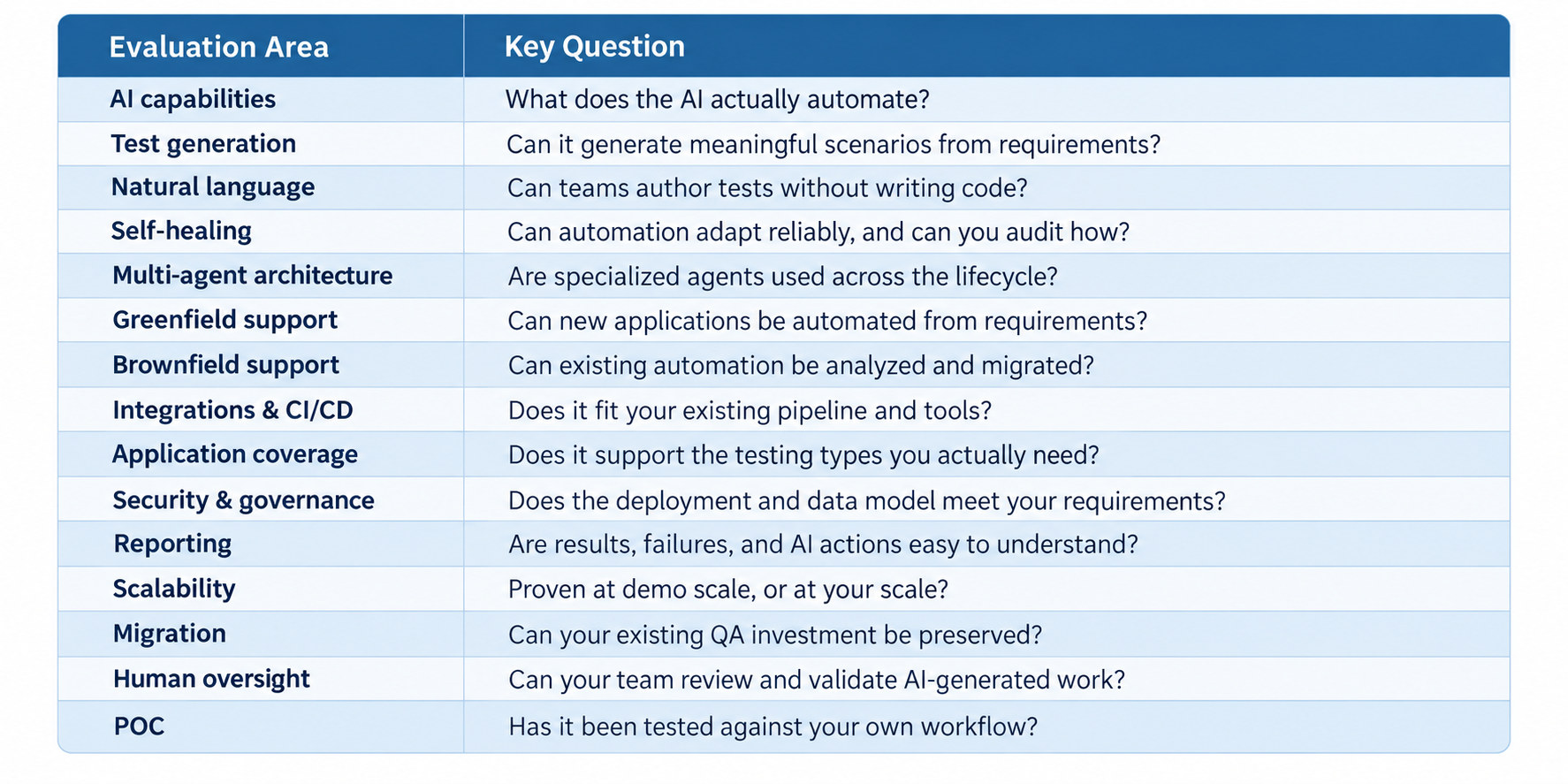
The checklist at a glance
What Should You Avoid When Choosing an AI Testing Platform?
- Don’t evaluate only the demo. A polished demo shows an ideal path. Test the platform against your application’s real complexity.
- Don’t equate AI with autonomy. An AI-assisted test generator and a genuinely agentic platform aren’t the same thing — ask specifically what’s autonomous and what still requires a human to drive it.
- Don’t focus only on test creation. Maintenance, execution, failure analysis, adaptation, and validation matter just as much — arguably more, since that’s where most ongoing QA effort actually goes.
- Don’t ignore your existing automation. Your current test suite represents real business knowledge. Understand how a new platform works with it, not just around it.
- Don’t remove humans from the process too early. Automating repetitive work is the goal — automating away appropriate oversight isn’t.
- Don’t take production-readiness claims at face value. The gap between a working pilot and a system a security or compliance team will actually sign off on is exactly where the trust concerns cited above tend to surface. Ask for evidence — audit trails, documented failure handling, real usage history — not just a confident answer.
Where Our Agentic AI Testing Tool – “IntelliQE“ Fits
IntelliQE, built by Jade Business Services, is one platform worth evaluating against this same checklist. It’s built around a multi-agent architecture with specialized roles for requirement understanding, test planning, automation generation, self-healing, and audit validation, each agent handling a distinct part of the lifecycle rather than one general AI model doing everything. It supports both greenfield and brownfield applications, integrates into existing CI/CD pipelines, and keeps human review in the loop by design rather than as an afterthought. If self-healing transparency and auditability matter to your evaluation and per the checklist above, they should that’s an area worth asking IntelliQE, or any platform you’re evaluating, to demonstrate directly rather than describe.
You can look at how its architecture maps to the criteria in this checklist on the IntelliQE solution page.
Conclusion
Choosing an agentic AI testing platform isn’t a matter of finding the tool with the longest list of AI features. The more useful question is whether a platform can solve your specific quality engineering challenges across the full testing lifecycle — requirements, generation, execution, adaptation, self-healing, existing automation, CI/CD, security, reporting, and human validation.
Test those capabilities against a representative workflow from your own environment before you commit. That’s the evaluation that tells you what a platform can actually do, not just what it claims to do in a demo.
Frequently Asked Questions
-
What is an agentic AI testing platform?
An agentic AI testing platform uses AI agents to perform or coordinate testing activities based on a defined objective. Depending on the platform, agents may support requirement understanding, test planning, generation, execution, failure analysis, adaptation, and validation.
-
How are agentic QA tools different from traditional test automation tools?
Traditional automation generally follows predefined scripts. Agentic QA tools use AI agents to interpret objectives, plan actions, adapt to changes, and coordinate different testing activities — with autonomy that varies by platform.
-
What should I look for in AI-powered test automation tools?
Test generation quality, natural-language authoring, auditable self-healing, execution and failure analysis, integrations, CI/CD support, security, reporting, scalability, existing-automation support, and human validation.
-
Are the best AI test automation tools completely autonomous?
Not necessarily. Autonomy varies by platform and use case, and for enterprise testing, human review of generated or auto-adapted tests typically remains important.
-
Can agentic AI testing work with existing automation?
Many platforms are designed for brownfield environments — analyzing existing automation and test cases and helping teams adapt or regenerate them. Verify migration and integration capability during a proof of concept rather than taking it on faith.
-
Can agentic AI testing integrate with CI/CD pipelines?
Yes, for platforms built to support it. Verify during evaluation how it connects to your specific pipeline, environments, execution triggers, and reporting.
-
Does agentic testing replace QA engineers?
No. It's better understood as automating and supporting parts of the testing lifecycle. QA expertise remains essential for defining quality objectives, validating results, managing risk, and judging whether coverage is actually meaningful.
