



What Is Agentic AI Testing?
Agentic AI testing is changing how software quality engineering teams approach test design, execution, and maintenance. Unlike traditional test automation, which relies on predefined scripts and workflows, agentic testing uses intelligent software agents to reason through testing objectives, plan actions, execute test scenarios, and adapt to changing application conditions.
For QA leaders, test engineers, and DevOps architects, this approach offers a way to explore more flexible testing workflows while reducing dependence on repetitive manual scripting. Understanding how agentic AI testing works, where it fits into enterprise quality engineering, and what organizations need for adoption is essential as software delivery becomes more complex.
Key Takeaways
Agentic AI testing uses intelligent agents to plan and execute testing activities within defined objectives.
Unlike traditional scripted automation, agentic testing can adapt its actions to application changes and observed results.
QA teams can use agentic approaches to support test generation, execution, maintenance, and broader testing workflows.
Successful adoption requires appropriate application access, clear requirements, integration with development workflows, and human oversight.
Agentic AI testing is an evolving approach that organizations can evaluate through practical, controlled implementation.
What Is Agentic AI Testing, Exactly?
Agentic AI testing describes a testing approach in which AI-powered agents perform tasks across the quality engineering lifecycle with a degree of autonomy. Instead of simply executing a fixed sequence of instructions, an agent can interpret a testing objective, determine the steps needed to achieve it, observe application behavior, and adjust its actions based on the results.
For example, a traditional automated test might follow a predefined sequence: open an application, enter credentials, select a menu, submit a form, and verify the result. An agentic testing workflow can use the same objective while dynamically determining how to navigate the application, identifying relevant test scenarios, and responding to unexpected application states.
The level of autonomy depends on the system’s capabilities, integrations, defined objectives, and validation controls. Agentic AI testing does not mean that every testing decision is made without human involvement. Enterprise implementations may combine autonomous execution with human review, approval, and oversight.
How Does Agentic Testing Differ From Traditional Test Automation?
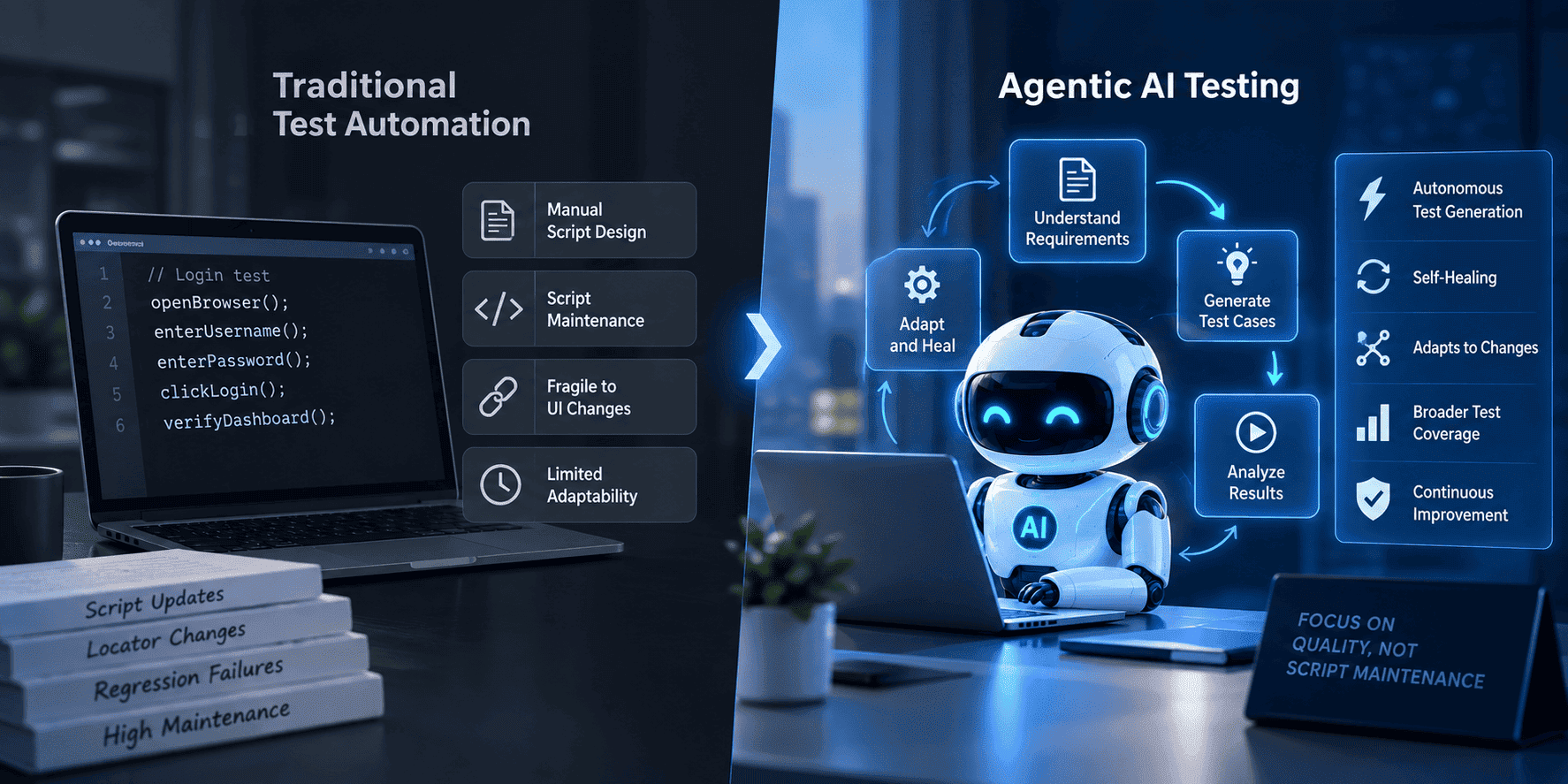
Traditional automation executes predefined test scripts created and maintained by test engineers. These scripts are valuable for repeatable testing, but application changes can require updates to selectors, workflows, test data, and expected results.
Agentic AI testing introduces intelligent agents that can support multiple stages of the testing process, including:
Understanding requirements and acceptance criteria.
Identifying test scenarios and potential edge cases.
Generating test cases and automation workflows.
Executing tests against the application.
Analyzing failures and identifying potential causes.
Adapting testing actions when application conditions change.
The distinction is not that traditional automation is no longer useful. Rather, agentic approaches extend automation by introducing greater adaptability and intelligence into workflows that previously depended heavily on predefined instructions.
What Makes an AI Testing System Agentic?
An AI testing system is considered agentic when it can pursue a defined objective by observing conditions, making decisions, and taking actions across multiple steps.
Common characteristics include:
Goal-directed behavior: The system works toward a defined testing objective rather than merely following a fixed sequence.
Planning: It determines the actions or scenarios needed to achieve the objective.
Tool use: It interacts with applications, test environments, repositories, or other connected systems.
Adaptation: It responds to changes in application state, execution results, or unexpected conditions.
Evaluation: It reviews outcomes and determines whether additional actions or validation are needed.
The degree of autonomy can vary. Some systems assist with test design or recommend actions, while others execute broader workflows under defined controls.
Why Does Agentic AI Testing Matter for Enterprise QA Teams?
Modern software applications often involve complex user interfaces, APIs, databases, third-party integrations, and continuously changing business requirements. As release cycles become more frequent, QA teams must maintain test coverage while managing script maintenance, defect investigation, and regression testing.
Agentic AI testing can support these challenges by introducing automation across multiple stages of the testing lifecycle.
1. Reduced Dependence on Repetitive Script Authoring
Test engineers often spend significant time creating and updating automation scripts for recurring workflows. Agentic systems can assist with generating test cases and automation based on requirements, application exploration, and defined testing objectives.
This can reduce the amount of repetitive authoring required, while allowing engineers to focus on reviewing scenarios, validating coverage, and addressing complex testing needs.
2. Greater Adaptability to Application Changes
Changes to user interfaces, workflows, and application behavior can cause traditional automation scripts to fail. Agentic systems with self-healing and adaptive capabilities can identify certain changes and adjust automation workflows accordingly.
The effectiveness of this process depends on the nature of the change, the quality of the agent’s analysis, and the validation mechanisms in place. Self-healing should support reliable maintenance, not bypass meaningful test validation.
3. Broader Testing Workflow Support
Agentic systems can coordinate activities such as requirement analysis, test planning, test generation, execution, and failure analysis. This creates opportunities to connect tasks that are often handled through separate tools or manual processes.
A broader workflow does not automatically guarantee complete coverage. Teams still need to define testing objectives, review results, and identify areas requiring specialized testing.
4. Support for Faster Feedback
When integrated into development and CI/CD workflows, agentic testing can help teams execute relevant tests as part of their delivery process. Faster feedback can help identify issues earlier in the development lifecycle.
The actual improvement depends on test scope, execution time, environment readiness, integration quality, and the complexity of the application.
What Happens When Testing Workflows Remain Fragmented?
Testing workflows can become fragmented when requirements, test cases, automation scripts, execution results, and defect tracking are managed across disconnected systems.
This fragmentation may lead to:
Repeated manual effort when transferring requirements into test cases.
Difficulty tracing test coverage back to business requirements.
Duplicated test scenarios across teams or tools.
Slower investigation of failures.
Limited visibility into the relationship between application changes and test outcomes.
An agentic quality engineering approach can help connect these activities through coordinated agents and integrations. However, successful implementation still requires clear ownership, reliable data, and appropriate system access.
Who Benefits From Agentic AI Testing?
Agentic AI testing can be relevant to several roles involved in software delivery and quality engineering.
QA Leaders
QA leaders can evaluate agentic testing as part of quality engineering modernization initiatives. The approach may help support test strategy, workflow standardization, and the management of testing activities across applications.
Test Engineers
Test engineers can use agentic capabilities to assist with test case creation, automation generation, execution, and maintenance. This can allow more time for exploratory testing, complex scenarios, and reviewing the quality of automated coverage.
DevOps Architects
DevOps architects can assess how agentic testing integrates with CI/CD pipelines, repositories, application environments, and reporting systems. Integration requirements and execution controls are important considerations when introducing autonomous testing into delivery workflows.
Engineering Managers
Engineering managers can evaluate whether agentic testing supports their team’s release processes, application complexity, and quality objectives. Adoption decisions should consider existing automation, team capabilities, security requirements, and measurable testing needs.
Does Agentic Testing Replace QA Teams?
No. Agentic testing is intended to support and extend quality engineering workflows, not eliminate the need for QA expertise.
Human involvement remains important for defining quality objectives, reviewing generated scenarios, validating test results, assessing risk, and making decisions about release readiness. The balance between autonomous execution and human oversight depends on the application, testing requirements, and organizational controls.
How Should Enterprises Implement Agentic AI Testing?
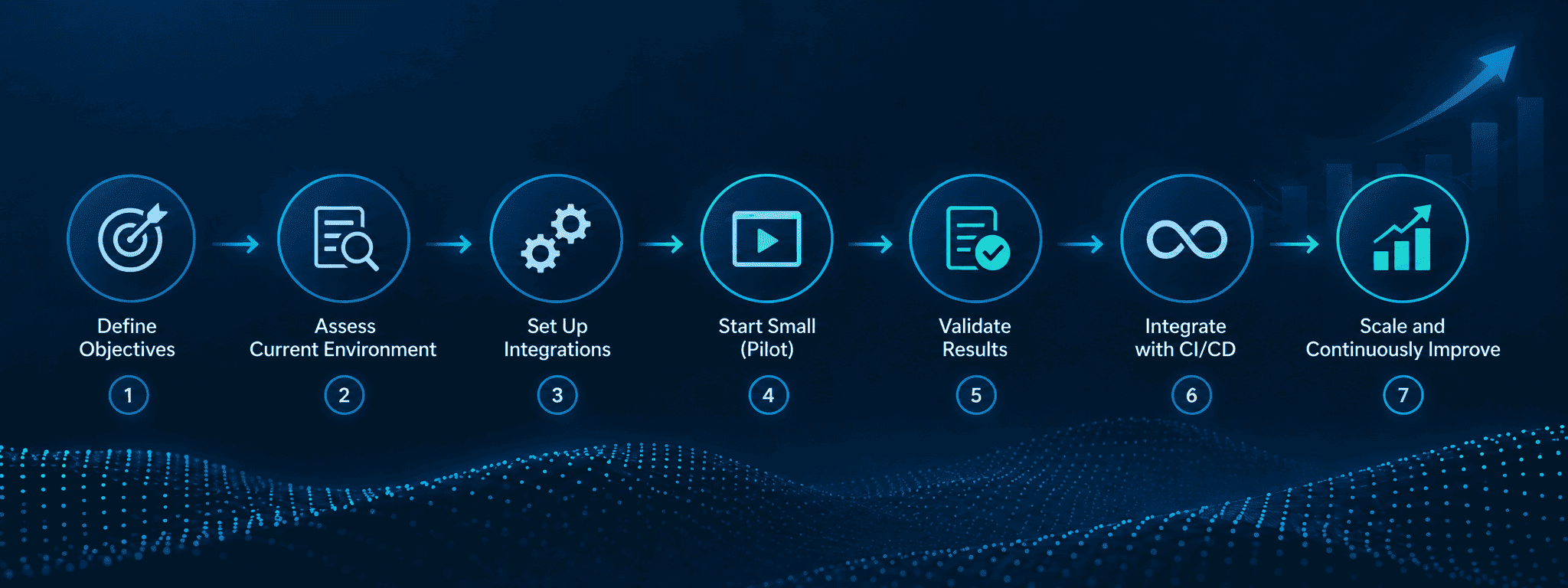
Enterprises should approach agentic AI testing through a structured implementation process. Rather than introducing autonomous testing across every application at once, teams can begin with a defined scope, evaluate the results, and expand based on their requirements and validation outcomes.
Step 1: Identify the Testing Objectives
Define the application, business workflows, testing types, and quality challenges that the initiative should address.
Examples include:
- Regression testing for frequently changing applications.
- Automated coverage of defined user journeys.
- Test generation from requirements and acceptance criteria.
- Maintenance of existing automation workflows.
- Integration of testing into CI/CD pipelines.
Step 2: Assess the Existing Testing Environment
Review current test cases, automation scripts, application environments, repositories, test data, and connected tools.
For brownfield applications, this assessment helps identify existing coverage, reusable assets, and potential gaps. For greenfield applications, teams can establish testing workflows and integrations from the beginning.
Step 3: Establish Requirements and Integrations
Agentic testing systems need appropriate access to the application under test and relevant supporting systems. Depending on the implementation, this may include requirements management tools, code repositories, CI/CD platforms, databases, test data, and notification channels.
Clear access controls and environment configuration are essential for reliable execution.
Step 4: Start With a Defined Scope
Select a manageable application workflow or test suite for initial implementation. Define the expected outcomes, validation process, and criteria for evaluating the results.
A controlled rollout allows teams to understand how the system behaves in their environment before expanding its use.
Step 5: Validate Test Results and Automation Quality
Review generated test cases, execution results, failures, and any automatically adjusted workflows. Human validation helps confirm that the system is testing the intended business behavior and that changes do not introduce gaps in coverage.
Step 6: Integrate With Delivery Workflows
Once the testing approach is validated, teams can evaluate integration with their CI/CD pipelines and existing development processes. The objective is to make testing a consistent part of software delivery while maintaining appropriate review and governance.
Step 7: Expand Based on Evidence
Use the results of the initial implementation to determine where additional testing workflows, applications, or integrations may be appropriate. Expansion should be guided by actual testing requirements, reliability, maintainability, and organizational readiness.
What Should Enterprises Consider Before Adopting Agentic Testing?
Agentic AI testing introduces new capabilities, but it also requires careful evaluation.
Application Complexity
Organizations should assess whether the application has the interfaces, workflows, and accessibility needed for the proposed testing approach.
Test Data and Environment Readiness
Reliable test data, stable environments, and appropriate access permissions help support consistent execution.
Security and Governance
Enterprises should evaluate data handling, credentials, access controls, auditability, and the permissions granted to testing agents.
Human Oversight
Teams should establish where human review is required, especially for generated test scenarios, self-healing changes, failure interpretation, and release-related decisions.
Existing Automation
Organizations with established automation should determine how agentic testing can complement, modernize, or gradually replace selected workflows without disrupting essential coverage.
Measurement
Evaluation should use relevant measures such as test coverage, maintenance effort, execution reliability, defect detection, and feedback time. Results should be assessed within the organization’s own application and delivery context.
Exploring IntelliQE for Agentic AI Testing
For enterprises exploring agentic AI testing, IntelliQE by Jade Business Services provides an AI-driven quality engineering solution designed to orchestrate intelligent agents across the testing lifecycle. Its capabilities include requirement ingestion, autonomous test generation, natural language authoring, self-healing automation, and CI/CD integration for greenfield and brownfield applications.
IntelliQE’s multi-agent architecture brings together specialized roles for requirement understanding, test planning, automation generation and execution, self-healing, and audit validation. This approach supports coordinated testing workflows while retaining human review and validation where required.
Explore IntelliQE to learn more about its approach to AI-driven quality engineering and autonomous testing workflows.
Conclusion
Agentic AI testing represents an evolving approach to quality engineering that brings intelligent planning, autonomous execution, and adaptive workflows into software testing. It can support teams working to manage application complexity, testing maintenance, and modern delivery requirements.
Successful adoption depends on more than introducing AI agents. Organizations need clear objectives, reliable integrations, appropriate governance, and human oversight to ensure that autonomous testing contributes meaningful value.
As enterprises evaluate new approaches to software quality, understanding the capabilities, limitations, and implementation requirements of agentic AI testing can help them make informed decisions about their testing strategies.
Frequently Asked Questions
-
What is agentic AI testing?
Agentic AI testing uses intelligent software agents to support testing activities such as requirement analysis, test planning, test generation, execution, and adaptation. Unlike fixed automation scripts, agentic systems can make decisions and adjust actions within defined objectives.
-
How is agentic AI testing different from AI-assisted testing?
AI-assisted testing may help with specific tasks, such as generating test cases, suggesting locators, or analyzing failures. Agentic AI testing focuses on coordinating multiple actions toward a testing objective, potentially across several stages of the lifecycle. The distinction depends on the capabilities and autonomy of the particular system.
-
Can agentic AI testing work with existing automation?
Yes. Agentic testing can be evaluated in brownfield environments where existing test cases, scripts, and tools are already in use. The implementation approach depends on the compatibility of existing assets, available integrations, and the organization's migration objectives.
-
Does agentic testing require human validation?
Human validation remains important for confirming test intent, reviewing generated scenarios, evaluating failures, and ensuring that automation changes preserve meaningful coverage. The extent of human involvement can vary by workflow and risk level.
-
Can agentic AI testing integrate with CI/CD?
Agentic testing can be integrated with CI/CD workflows when the solution supports the required pipeline, repository, environment, and execution integrations. IntelliQE's documented capabilities include CI/CD integration for enterprise quality engineering workflows.
-
Is agentic AI testing suitable for greenfield and brownfield applications?
Agentic testing can support both. Greenfield implementations establish testing workflows for new applications, while brownfield implementations work with existing automation, test cases, and delivery environments.
-
What should a company evaluate before adopting agentic testing?
Organizations should assess application complexity, existing automation, requirements quality, environment readiness, security controls, integration needs, human validation, and the testing outcomes they want to measure.
